
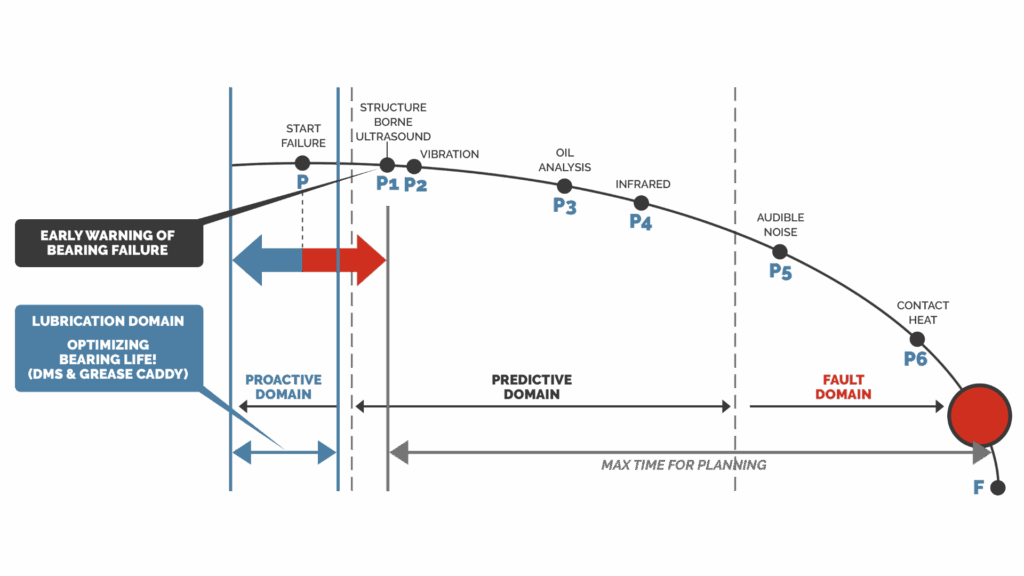

It has been said that at least 60% of premature bearing failures can be attributed to lubrication. Ultrasound instruments can be used to prevent over and under lubricated bearings. Since the source of ultrasonic noise is friction, when a bearing is in need of grease, there is an increase in friction; therefore, an increase in noise or decibel level. When listening to the bearing that is in need of lubrication and watching the decibel level on the display of an ultrasonic instrument, as grease is applied the inspector would notice a gradual drop in the decibel level, and eventually back down to a more normal level. If the bearing is already over lubricated, as soon as grease is applied, the inspector would notice a gradual increase in the decibel level, letting them know that the bearing already had enough grease.
How Do I Get Started?
There are two common questions that many first-time users of ultrasound have. The first is, “how do I set baselines?” The second is, “how do I know if what I’m listening to is good or bad?”
The Comparison Method
One way to get a quick idea as to what is good and what is bad is by using the comparison approach. With this method, the inspector simply compares the decibel level readings at identical points on identical machines. The baseline can then be set based off an average of decibel levels at the compared points. The software may even default to the first reading taken and downloaded. The baseline can then be changed as more readings are collected.
The Historical Method
Using this method, the inspector first establishes a route or database in the ultrasound software. The database is then loaded into the ultrasonic instrument. Data is then collected at the various points along the route. When the initial round of data is collected, it may be necessary to collect data more frequently than needed in order to build the history, and get an idea if the decibel readings are remaining similar in the historical readings.